
Inspirations
The biggest inspiration for my guitar building comes from science. "Three of the most important words in science are I don't know." Not knowing implies a universe of opportunities—the possibility of discovery and surprise. This passage is part of the preface to Lawrence Krauss's book The Edge of Knowledge. The same scientific "I don't know" moves the world forward, allowing for exploration and a deeper understanding of particle physics, cosmology, and the acoustics of stringed instruments. It always assumes a lack of final, indisputable knowledge. I believe I understand how a guitar works quite well, but I am ready to change my view if discoveries challenge current knowledge. This is especially true given that a guitar is such a complex system, and we currently operate only on greatly simplified models.
The person who influenced my work the most is Ken Parker. I have incorporated many of his design ideas into my guitars, and I am grateful for Ken's generosity and encouragement.
I never wanted to build a traditional guitar simply for the sake of tradition. Everything evolves. Would you like to ski on skis designed in the 1950s? High-tech wooden tennis racket, anybody? There is much to draw from tradition in guitar building; Lloyd Loar's L-5 was a truly revolutionary instrument. However, the combination of the 1930s economic crisis and the electrification of guitars stalled the archtop's evolution prematurely. Traditional guitar design can and should be improved. Copying the L-5 with minor aesthetic tweaks held no interest for me. When I began designing my guitars and searching for solutions, Ken Parker became my hero.
Ken Parker, like Jimmy D'Aquisto, focused on the further development of the archtop guitar. Whenever Ken identified an inherent problem with traditional archtop design, he did not hesitate to break "the rules". His solutions, at times, are revolutionary. I do not copy Ken's guitars, however; I have made fundamentally different design decisions in several crucial areas.
There are others who inspire my work:
- Joseph Curtin, a superb American violin maker and innovator;
- Jim Woodhouse, a professor of engineering and author of an excellent online resource on the acoustics of musical instruments (https://euphonics.org/);
- Helen Michetschläger, from whom I learned the traditional method of pre-bending plates for violas;
- Kim Walker, who gave me the confidence to integrate a structural main beam inside the instrument's body;
- Linda Manzer, whose guitars are chosen by many of my guitar idols—Pat Metheny foremost among them. This fact leads me to study Linda’s guitars under a magnifying glass;
and many others.
Some of my inspirations stem from historical instruments. For example, I designed my tailpiece hinge taking inspiration from the viola da gamba (shown in the image). The operating principle remains the same, but modern materials allowed me to make it smaller, stiffer, and lighter. Additionally, I added the ability to adjust the string break angle over the bridge, which alters downward pressure on the soundboard and fine-tunes the instrument's acoustic response.
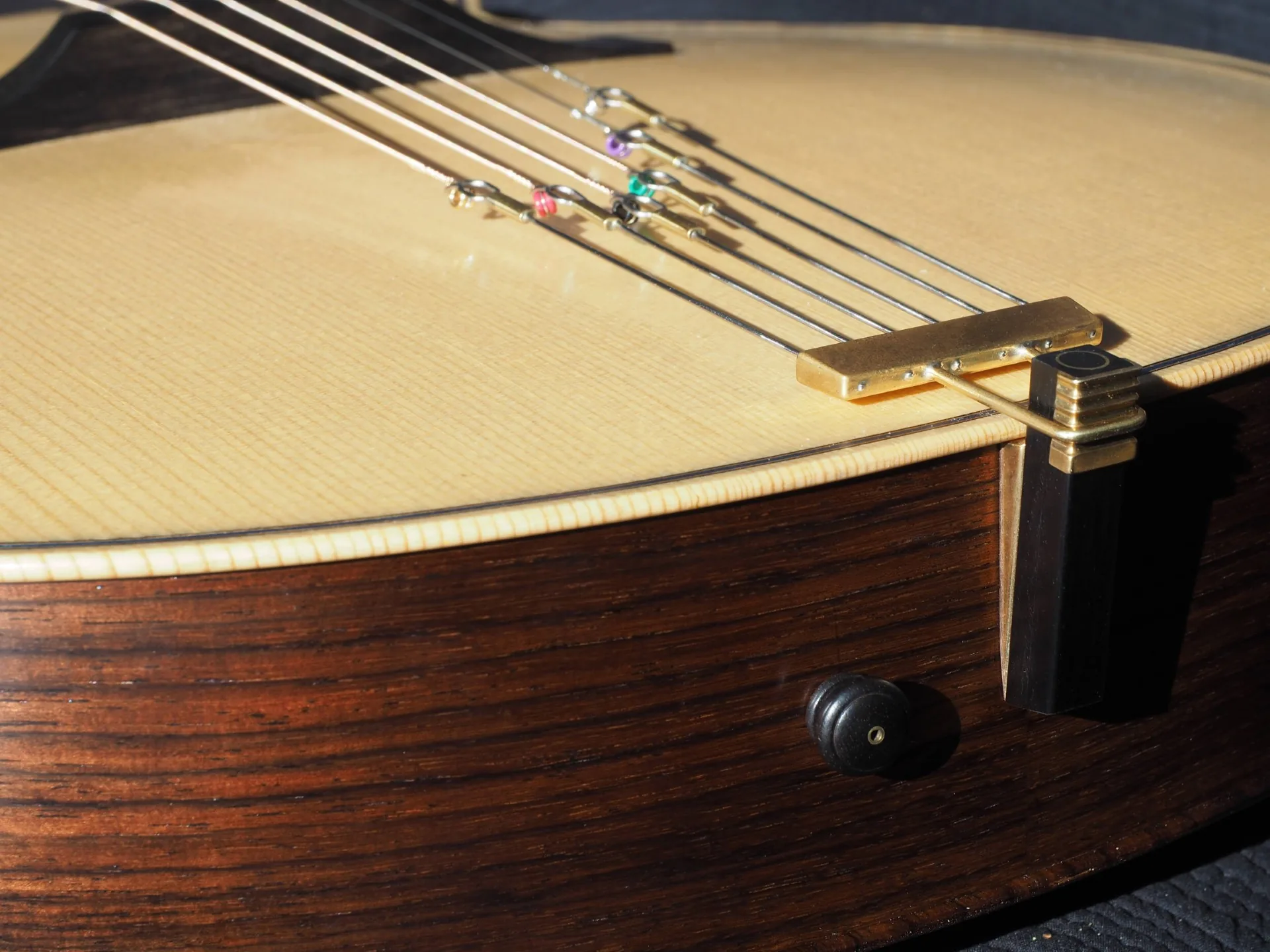
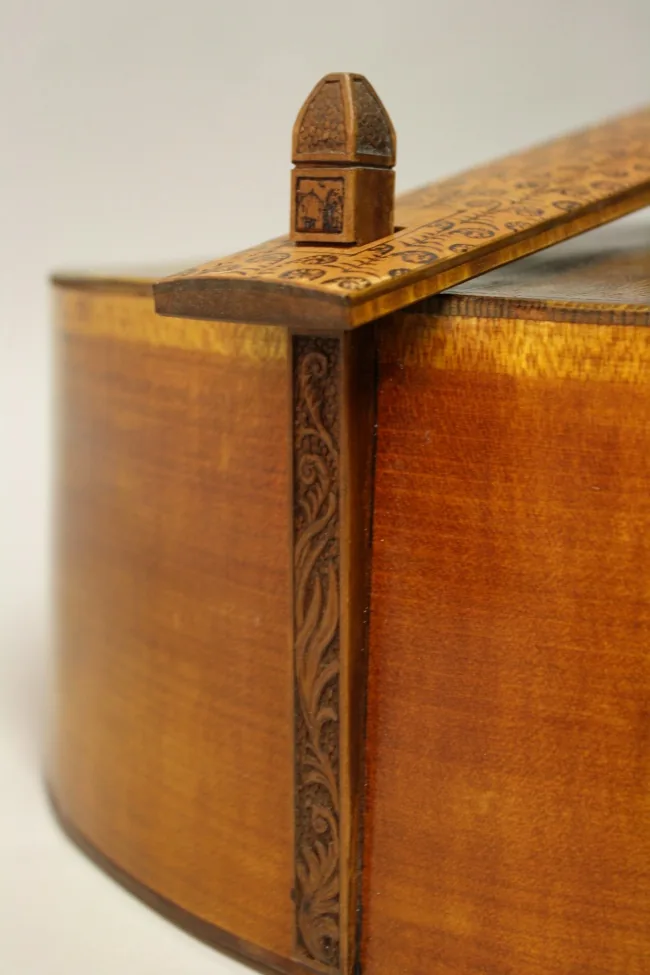
Hundreds of design and aesthetic choices are embedded into each hand-crafted instrument. Metaphorically speaking, one might say that the builder embeds their DNA into the final product. Indeed, this is true. One should not forget, however, that this DNA is partially inherited from the great luthiers of the past. It is easy to recognize Parker's influence in my instruments, but I have also drawn from Lloyd Loar's L-5, Kim Walker's Solo Novo, Jimmy D'Aquisto, and others. The evolution of a fine instrument relies on every successful preceding generation. When innovating, we aim to discover new and improved paths while avoiding dead-end evolutionary paths. The structural DNA of the past remains essential.
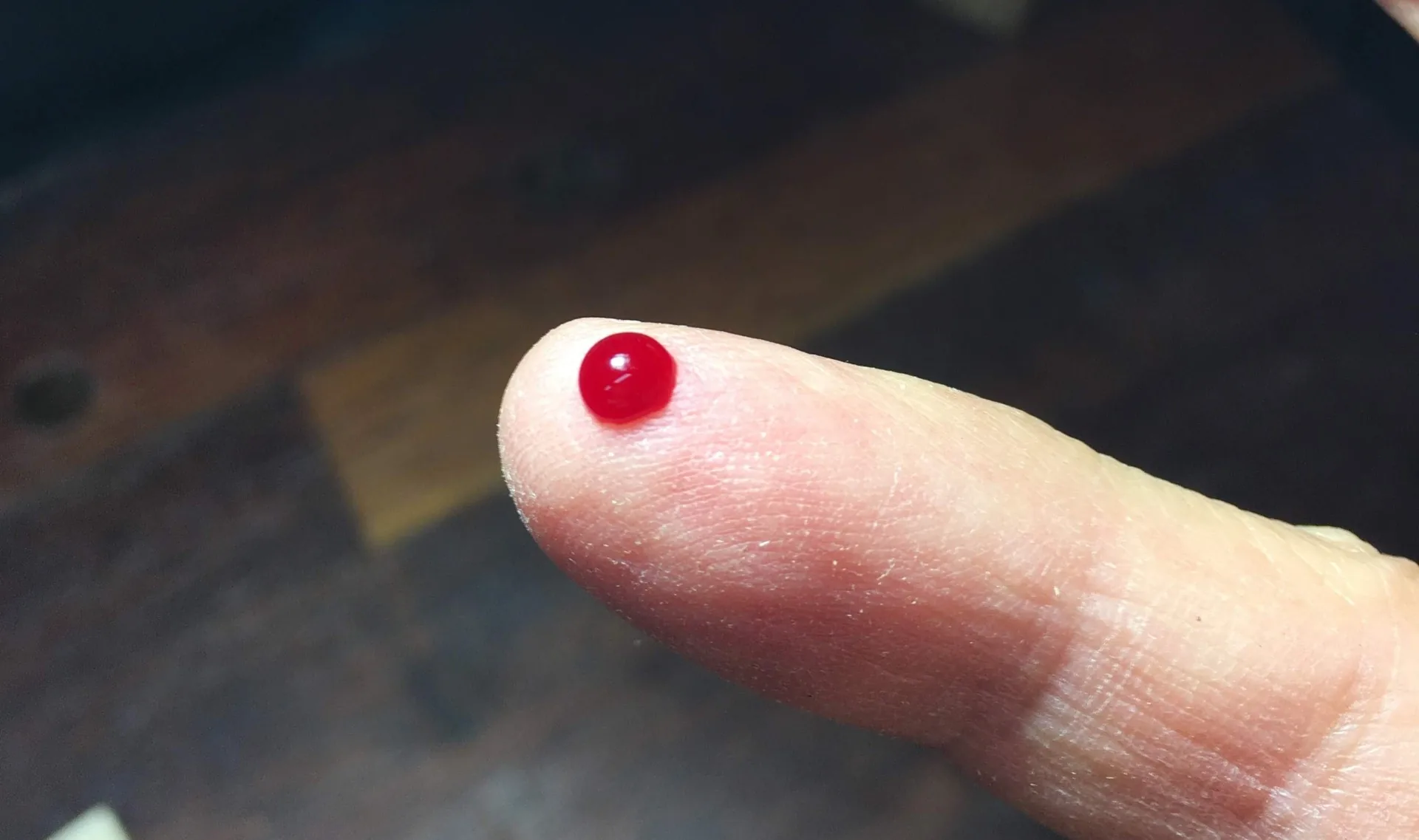
Beyond the metaphorical, crafting a new instrument by hand is a long, physically demanding process that introduces another form of DNA. Building by hand requires considerable physical effort, and it is not uncommon for a drop or two of sweat—or blood—to be shed and permanently sealed within the instrument. A builder's DNA is thus embedded into the guitar both metaphorically and literally.